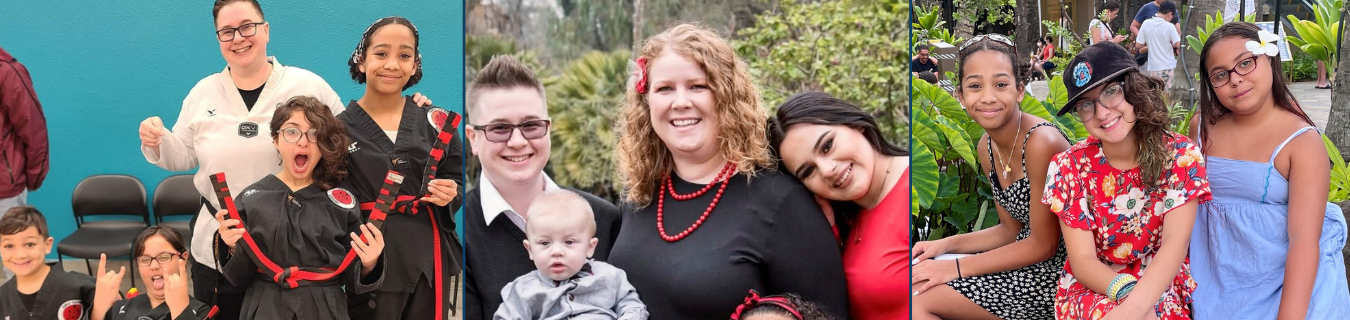
What is home? For many of us, we will say an address or point to a neighborhood on a map. We might say home is someone or something familiar we are fortunate enough to keep returning to. But for hundreds of foster kids in Sacramento County, a home can be much harder to define and belong in – particularly one where they feel like they fit in. More than ten years ago, Britney and Erin Eason decided they would become a home for both children and teens who needed a safe space to feel accepted and loved.
Sitting on their couch one summer afternoon, surrounded by three very talkative tweens, a babbling baby and one quieter child – Britney and Erin shared their journey to becoming resource parents in Sacramento County.
“People will always say, ‘the kids are so lucky to have you,’ and that’s not it. We are lucky to have these kids. They are going through the hardest time of their lives. They are not lucky. They’re picked up, swooped up and they’re put in a stranger’s home,” Erin explained.
“Maybe a really cool stranger's home with some really cool pets, but we're still strangers, right?” Britney added, gesturing at their home filled with animals – including an iguana, one cat, several spiders and two very friendly Irish wolfhounds.
Britney and Erin said what many people might not realize is even in a supportive foster home, kids and teens will face challenges many of us may never think about.
“We have different foods, different rules, different smells. They don't have their favorite blankies or their favorite stuffies. They don't have the clothes that they like to wear. They may have to change schools. We try to keep them as plugged in as possible, but they may have to,” Britney said.
A difficult but rewarding journey
“When we moved into this house, a bigger house, our goal was to have more kids in general,” – Britney, resource parent.
While fostering comes with challenges, Britney and Erin say they would not change this incredible journey. The couple became resource parents when there was a need to provide a home to a relative’s child – their now-adopted daughter Leilani. Since then, they’ve helped provide a home for more than 40 children and teens in foster care, and they have adopted five of the kids who came into their care.
“I like that both of my moms are very passionate about what you love and, like, the activities that you're into,” Leilani said.
41 and counting: The number of kids and teens the Eason family has fostered over the years
Once Britney and Erin became licensed resource parents through Sacramento County, they felt called to continue helping kids, even eventually moving to a larger home so they could foster additional children.
“When we had our license, our initial goal, moving from the smaller house into this house, was to be able to have more kids in general. But once we got here, we realized there was a big need for sibling sets. So that was kind of how we started, was getting, like, sibling sets of, like, two to five,” said Erin.
Erin’s reference to “sibling sets” refers to Sacramento County’s efforts to keep siblings who are removed to be placed in the same home as often as possible. It can be challenging to find resource homes for sibling sets, as some licensed parents may not have enough space or may already be fostering other children.
From young children to Teens – How keeping an open mind made a lasting impact
“When I met Erin, that kind of changed my life.” – Jalen, former foster youth who lived with Britney and Erin
“We left our license open from zero to 18, so we eventually started getting calls for teenagers,” Britney said.
When Britney and Erin began fostering, they wanted to stick with children because of fears over safety issues since Leilani was young at the time. That mindset stuck – until Erin went to meet 15-year-old Jelan.
“I had something going on, and so I wasn’t there, but she came back [from meeting Jelan], and she was like ‘yep, that’s my kid,’” Britney explained.
Jelan is now in his 20s, and he keeps in touch with Britney and Erin through video calls and comes over for dinner.
“I think I was 15 going on 16, so around 2015. It was around that time that I met Erin. I was at the receiving home at that time, and I was going in and out of the receiving home,” Jelan said.
Why Inclusion matters: Approximately 30% of foster youth identify as LGBTQ+
The Children’s Receiving Home provides temporary congregate placement for foster youth who are waiting on a resource parent or relative placement. Many of the youth they serve are teens. And for Jelan, a gay teenager – finding an understanding home over a decade ago was challenging.
“I was very persistent in advocating for myself to get a home because I didn’t want to stay in the dorm for too long,” Jelan said.
Jelan represents a large number of foster kids in Sacramento County. According to data, more than a third of children in foster care identify as LGBTQ+. But Jelan said that shouldn’t matter – resource parents should accept children no matter what. Jelan says he will never forget meeting “mama Erin” for the first time and how she immediately accepted him for who he is.
“When I met Erin, that kind of changed my life.” Jelan felt so happy in his new home – that he wanted to share that love.
He met foster teen Lottie at school – he said he could tell she was going through a difficult time and approached her.
“I was going to a new school. We had class together, and I was quiet. I was just kind of, like, living day by day, just trying to figure out what I'm doing the next day, how I'm surviving, all the things. And so, he came up to me and kind of burst my bubble,” said Lottie.
The teens started talking about their pasts and living situations – quickly becoming friends.
“So, one day I was just like, 'Can I meet your moms? Like, I want to know,’ like, it sounded so good, I just didn't believe it, so I was like, ‘I want to meet you. I want to see this,’ said Lottie. “And so, um, he went back and told them about me, and then one day, uh, Mama Brittany was coming up in the truck, and I was like, ‘Hey,’ like, ‘I want to move in with you,’ like, ‘Can I be your new daughter?’”
Eventually, Lottie made the move into Erin and Britney’s home. She is now in her 20s and has a child of her own. She still keeps in touch with the Eason family – and they continue to support her by offering advice as seasoned parents and by being the occasional babysitters for Lottie’s child.
It takes a village – the resources and staff that made it possible for Britney and Erin to change lives
The Eason family fosters through Sacramento County’s Department of Child, Family and Adult Services. They said the resources and classes provided by the County helped build their confidence as parents.
“We’re able to find whatever supports are necessary – whether it’s educational, mental health, physical health, whatever it may be, we're able to really get peer mentors, family advocates, whatever we need and whatever the kids need,” said Brittany.
As of July 2026, more than 800 kids and teens were in foster care in Sacramento County. Many of the youth placed in foster care are in supportive homes – but some are still waiting for placement. On average, 15 kids are usually awaiting placement. Britney and Erin are aware of the need for more resource families and said they always start conversations about how others can get involved – even when they’re meeting strangers in public.
887: The exact number of kids in Sacramento County Foster Care as of July 1
“I tell strangers that I meet if they come up and talk about our kids … that they can just contact the county. Get set up with orientation. It doesn’t cost anything. It’s free. Just go down there, ask questions,” said Erin.
Erin is right; there are regularly scheduled orientations where people can go and ask social workers and other staff questions about the requirements and what it’s like to be a resource parent. No commitment is required at the initial orientation. You can find a list of upcoming orientations on the DCFAS website.
“There’s no rush. The County doesn’t pressure you to rush,” said Erin.
Once a potential resource parent completes an orientation, they can start the interview and application process at their own pace. You can read a full list of requirements for resource parents on the DCFAS website. Going through the process not only changed Britney and Erin’s lives but the lives of the dozens of youths they’ve helped over the years.
“I still looked at them as family, like, over the top. Like, they've done things for me that my family has not even done, and that's, that's why I stand by, you know, blood doesn't make you family. It's really about the things that people do and the stuff that, the actions and the care of love, you know, and the way they show love. So, I really appreciate Erin, and just Brittany and everyone who was involved in my life, cause that did impact me. I don't know where I would be. You know, I'd probably be somewhere else if I wasn't placed in their house,” said Jelan.
The words from Jelan are emotional for the two moms. Erin said those words are also an important reminder about why they chose to help kids and teens in need – even when those children were struggling sometimes with grief, the loss of their home, anger and anxiety.
“We’ll figure it out. We’ll get through it together. We’re going to find a way to make this work, you know? And we’re still supporting those kids in the transition from our home to wherever it is their next place may be.”
Fostering is not for every family. But every child deserves a family and a support system.
Currently, there are 539 families approved to foster in Sacramento County. More than 300 of those families are relatives or non-related family members (NREFM). A NREFM placement can refer to a person known in a foster youth’s life, like a pastor, coach or tribe member, that the child already has a relationship with. Being placed with family or an NREFM can sometimes ease the transition into foster care because the child is not placed with a stranger. However, not every family has people they can rely on during difficult times that lead to youth ending up in foster care, and applications are always open for people to become resource parents.
“We could not do this without our resource parents, the families who are willing to step in for the children in their lives, and our non-related family members, and all our community partners,” said Child Protective Services Deputy Director, Melissa Lloyd. “It is a privilege to know so many people who help our foster youth during what is often one of the most difficult times in their lives. Over the more than 25 years I’ve worked with Child Protective Services, I’ve seen so many people rally around these kids and lift them up – but there is always a need for more support. This commitment and the day to day responsibility of caring for foster kids are not always easy – but we must realize that it is often much more difficult for the youth who are placed into our care.”
If you are interested in helping a foster youth but are not in a situation to become a resource parent, you can still support the youth in different ways:
Gifts from the Heart: Since the 1980’s, Sacramento County employees have gathered
donated gifts for foster youth and older adults in need. The gifts and any financial donation go directly to foster youth or adults who are Adult Protective Services Clients. Recently, the program leaders realized there was a year-round need for basic items and birthday presents. Reach out to GFTH@saccounty.gov to find out how you can make a difference.
Sacramento LGBT Community Center: A community partner that helps all LGBT youth with a welcoming space. More than one-third of Foster Youth identify as LGBTQ+. You can find out about how to donate or volunteer by visiting the Sacramento LGBT Community Center website..
Sacramento CASA Program: A volunteer-based program that supports foster youth. You can become a CASA (Court Appointed Special Advocate). As a CASA, you advocate for the needs of the child you are matched with. A CASA gets to know a child’s situation, communicates with professionals on the case, and makes sure the child’s needs are being met. CASAs also get to enjoy fun activities with the child they are assigned – many take them out for activities like bowling or going to the park so the child can find joy during a stressful time in their lives.
Moving forward as a community:
Home isn't always the place where you're born or the address on your driver's license. Sometimes, it's the people who choose you, stand by you, and remind you that you matter. For Jelan, Lottie, Leilani, and so many others, Britney and Erin didn't just provide a place to sleep; they gave them something every child deserves: a home and a sense of belonging. Britney and Erin’s story is a reminder of what is possible when a community chooses to show up for its children and teens. Every child deserves a place to belong—and together, Sacramento County can help make that possible.